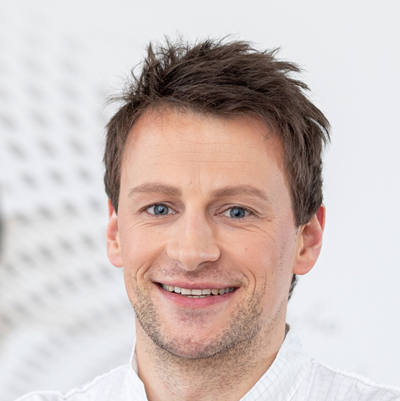
Patrick Rietschel
Group Head of Complications at A. Lange & Söhne
Paolo Ciurcina
Watchmacher, Les Ambassadeurs
Patrick Rietschel: To understand that, you have to go back to 1994 when Walter Lange and Günter Blümlein presented the first Lange watches of the modern era at the Royal Palace in Dresden. Anyone who was familiar with the pocket watches from A. Lange & Söhne at that time probably expected something more traditional. And then along came the Lange 1 with its provocative asymmetry, the large date and a three-day movement.
What made the Lange 1 a legend?
Paolo Ciurcina: The Lange 1 has been part of the collection since the very beginning; it is also the embodiment of the relaunched brand. The off-centre time display and the large date turned this model into a legend. In 1994 that was something entirely new and pioneering in design.
Patrick Rietschel: The finish is very extensive, similar to a watch with the Geneva seal, but it has a different character. With Lange watches, for example, typical features are the three-quarter plate made from nickel silver with a Glashütte satin finish, the screwed and polished gold chatons for fixing the ruby jewels and the hand-engraved balance cock with a swan neck spring. In addition, with us every movement is double mounted, no matter whether it’s a three-handed watch or a complication.
The finish of Lange movements is seen as unsurpassed. How do I detect these differences as a customer?
Paolo Ciurcina: The watch movements from Lange & Söhne are works of art. Anyone who holds one of their watches in their hands is bound to notice that. You immediately see the high-quality finishing and the decoration in the movement. Even the blued screws and the jewels set in gold chatons strike you immediately and demonstrate the quality and workmanship that the brand applies to its watches.
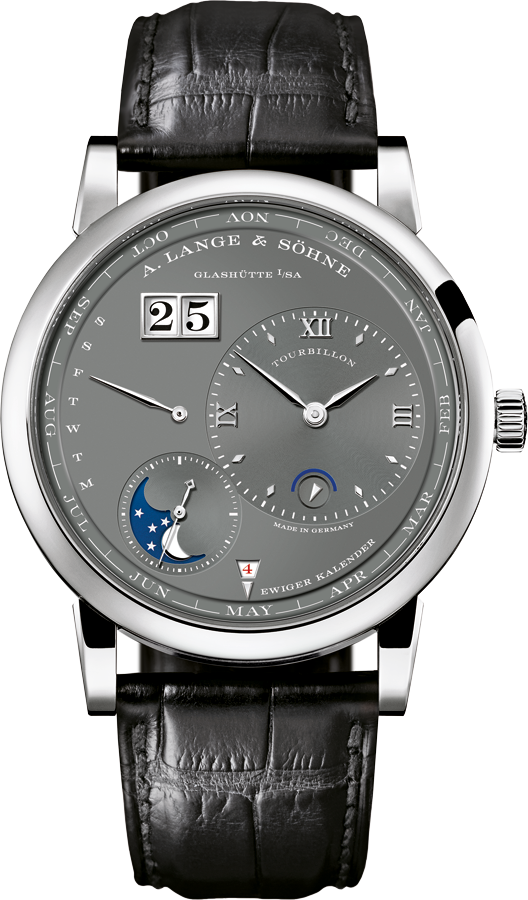
Patrick Rietschel: It is right that the tourbillon cannot be seen on the dial side. Instead, small curved lettering points to it at twelve o’clock. Our designers’ aim in designing this watch was to create the greatest possible clarity and arrange the displays so they can be grasped at a single glance, because perpetual calendars are often very hard to read. That’s why they have dispensed with everything that might impair the readability and have deliberately arranged the tourbillon on the rear of the movement.
The dial of the Lange 1 Tourbillon Perpetual Calendar reveals nothing about the tourbillon. How do you explain that?
Paolo Ciurcina: It is a fact that Lange & Söhne places a great deal of value on the clarity of design, and skeleton surfaces are rare. That is also connected with the history of the manufacturer. Historical pocket watches often contained complicated movements, but did not allow this to be seen from the outside. This reticence sets the design of watches from A. Lange & Söhne delightfully apart from other brands which aim to impress their entire inner life on the observer right away.
Georg Wellendorff
CEO and Product Director, Wellendorff
Inga Szalontai
Team Leader for Jewellery, Les Ambassadeurs Zurich
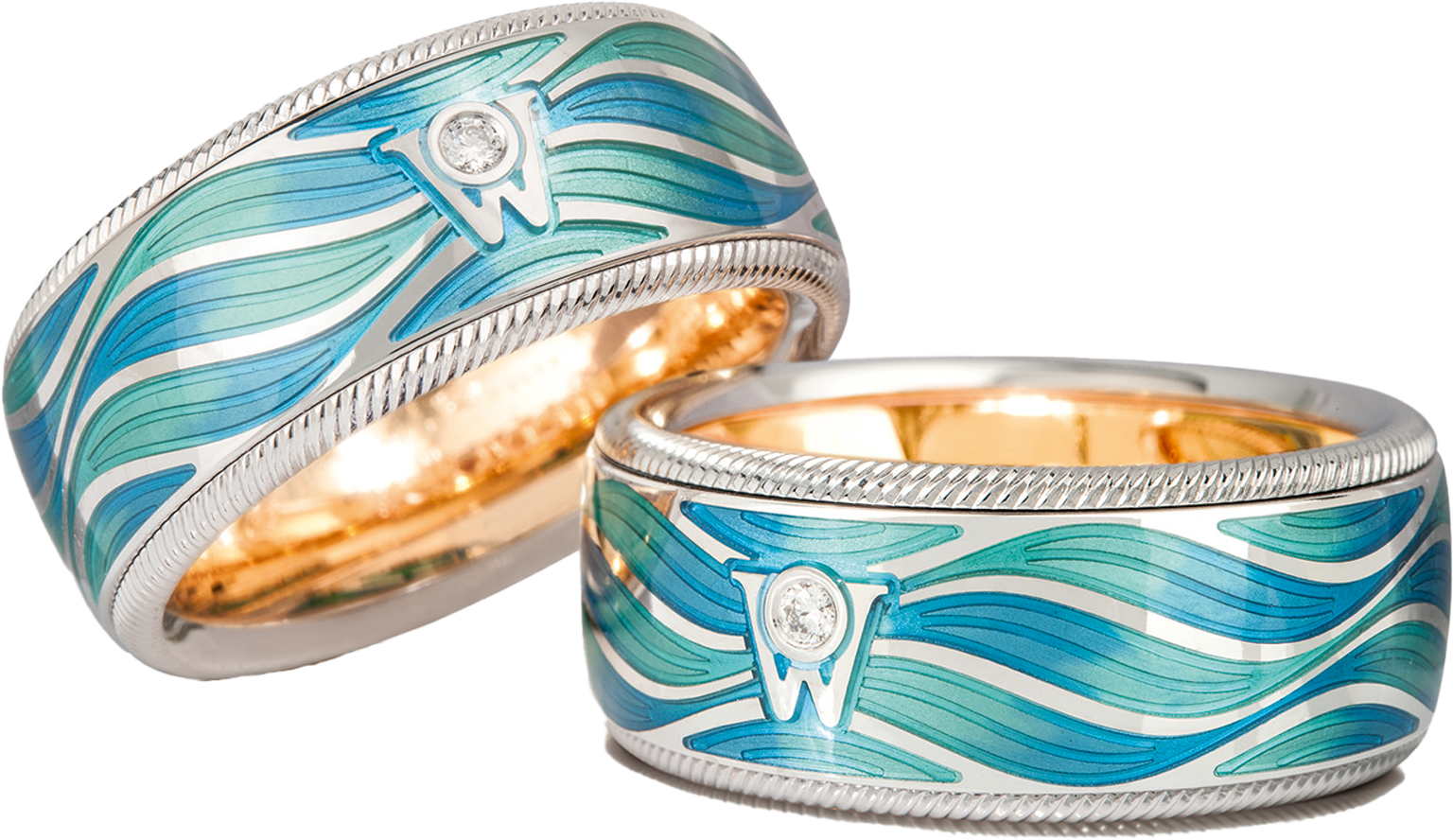
Georg Wellendorff: The ring bands and rotatable elements in our Wellendorff rings are manufactured to a high level of precision and comply with extremely strict tolerances. The rotating elements therefore do not have any play and do not allow any foreign objects to get inside. Thanks to these strict tolerances, our rings also do not require any additional mounting. You can imagine that the manufacturing complexity increases with every additional rotating element. There are as many as four separate rings in the “Magic Waves” ring.
How do you ensure that the moving parts always remain easy to turn?
Inga Szalontai: The firm of Wellendorff has many secrets. The rotatable ring is one of them. This model consists of four parts. You can adjust the size of the inner ring within a certain range. This makes it possible to adjust even an existing ring if the customer wishes.
Georg Wellendorff: Unlike conventional enamel, a cold enamel specifically developed for the demands of jewellery can withstand the expansion of the gold and thus even extreme stress. This material was specifically developed for high-quality gold jewellery (and of course we won’t disclose its composition). It is shock-resistant and also has excellent adhesion.
What precisely do you understand by cold enamel? It is used frequently by Wellendorff.
Inga Szalontai: Cold enamel is an artificial resin mixed with colour pigments, which hardens very well. It is suitable for making jewellery because it does not have to be fired in a kiln and is more shock-resistant than enamel made from glass powder. It looks very beautiful and is more durable and robust than fired enamel.
Georg Wellendorff: Our cold enamel is available in different colours that can also be combined to achieve colour gradients that remain separate. With the Magic Waves ring, for example, turquoise and azure blue colours flow into one another and allow you to see the deeper, wave-shaped engraved surface underneath. Pearl pigments can also be added to the transparent enamel to create a mother-of-pearl effect. The finest engravings are distributed across as many as three levels. These different levels give the pieces of jewellery their depth and a magical luminescence.
How are the different colour tones achieved in transparent enamel?
Inga Szalontai: The depth effect in transparent enamels is created by applying it to indentations on the metallic surface. The deeper the cavity, the darker the hue. The background in gold can be engraved in such a way that you can see the engraving through the enamel as if looking through a smooth watery surface. The gradations of depth influence the intensity of the colour. You can see that especially well with the ring, which actually reminds you of water.
Georg Wellendorff: We are a family-run business, now in its fourth generation, that has been making jewellery from 18-carat gold for over 127 years. We are the only international company that is still in the hands of the founding family. Two of our creations have become style icons: the Wellendorff rope necklace and the Wellendorff ring, which specialists describe as the “softest necklace” and the “most vibrant ring” in the world. Each of our jewellery pieces bears the trademark diamond W, which also guarantees that our jewellery is made in Germany.
What makes the Wellendorff brand stand out?
Inga Szalontai: I like Wellendorff jewellery because it speaks an entirely different design language compared to brands from France and Italy. The German family company concentrates on the things it can do especially well: the flowing gold rope necklace and the rotating rings. Instead of a quantity of coloured gemstones, the cold enamel takes on the task of breathing vibrant colour into the pieces.
Hervé Morard
Workshop Manager at Urwerk
Salvatore Cucinotta
Watchmaker at Les Ambassadeurs in Lugano
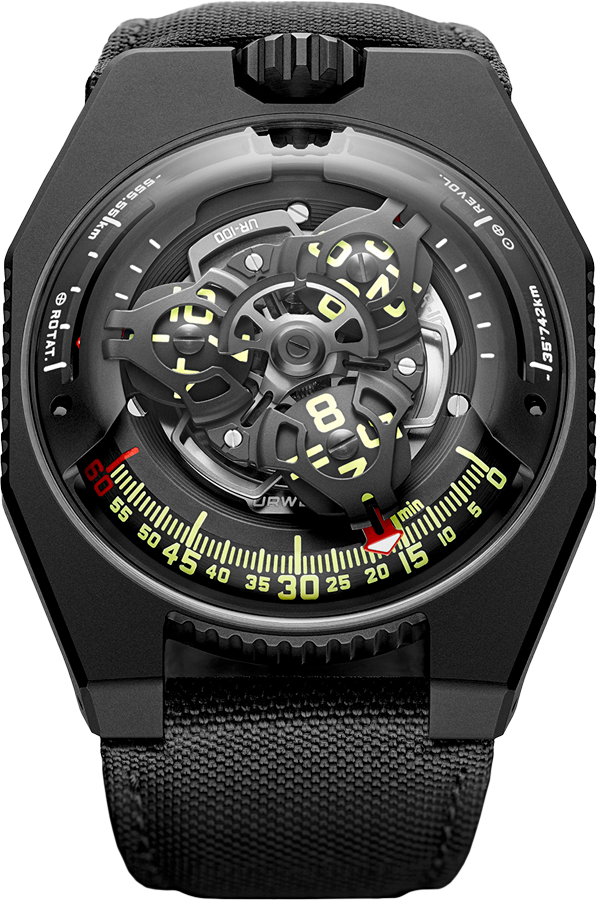
Hervé Morard: The time display using satellites. That is a poetic way of representing time. With this model there are no hands: the hours literally glide in front of us. This makes the passage of time even more vivid and concrete. As a result, telling time is much more playful than would be possible with hands.
What about this model is typical of Urwerk?
Salvatore Cucinotta: Typical for Urwerk is the time display using so-called satellites with numbers for the hours that glide across a minute scale. The first Urwerk model from 1997 already had this system. There are Urwerk models with three satellites and some with four. The UR100 shows the time with three satellites, each with four hour figures.
Hervé Morard: The watch displays the hours and minutes. In addition, there are two further displays on the lunette, each of which covers a period of 20 minutes but which also represents distances. One refers to the rotation of the Earth measured at the equator, where a point covers 555 kilometres in 20 minutes, and the other refers to the path the Earth travels on a solar orbit within the same period.
What is the UR100 model able to display?
Salvatore Cucinotta: Apart from displaying the hours and minutes, the UR100, which also bears the name “SpaceTime”, has two side displays that represent how many kilometres a point at the equator covers in 20 minutes due to the Earth’s rotation and the route the Earth travels itself on its orbit around the sun in that period.
Hervé Morard: Martin Frei is without doubt the most inventive and most open person I know. He is interested in almost everything: nature, architecture, art, which of course he studied himself, and even music. But above all he sees everything that surrounds him with a new, unbiased eye. When he is in the Geneva workshop – he has his office in Zurich – he always takes an unbelievable number of photos. That way he teaches me every time to see my own work from a different perspective.
Martin Frei, one of the brand’s founders, is the designer at Urwerk. Where does he get his inspiration?
Salvatore Cucinotta: I have followed the development of the Urwerk models attentively and every one reminds me of a spaceship. Sometimes I think Martin Frei is a Star Wars fan. If you look at the ER100 from the front, it bears similarities with Han Solo’s “Millennium Falcon”.